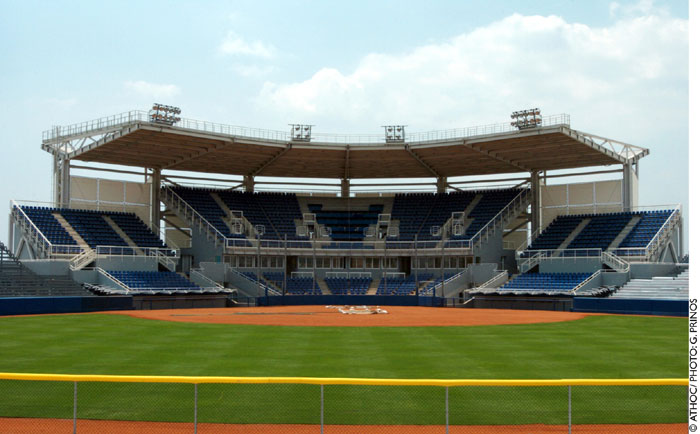
Softball
Softball is a team sport in which a ball, eleven to twelve inches (or rarely, 16 inches) (28 to 30.5 centimeters) in circumference, is thrown (pitched) underhand by a player called a pitcher and hit by an offensive player called a batter with a round, smooth stick called a bat (usually wooden, metal or composite). Scoring is accomplished by the batter running and touching a series of three raised markers on the ground called bases, and then touching the final base, called home plate. Thus in the shape of a house facing away from the pitcher. Softball is a direct descendant of baseball, which is sometimes referred to as hardball to distinguish the two, but differs from it in several ways. This article assumes no knowledge of baseball.
The sport's governing body, the International Softball Federation holds world championships, held every four years, in several categories.
The sport's governing body, the International Softball Federation holds world championships, held every four years, in several categories.
Types of softball
There are three general forms of softball: slow pitch, modified pitch and fast pitch.
Fast Pitch softball is a very defensive, pitcher-oriented game. The pitcher delivers the ball at maximum speed with little to no arc. The ball is colored bright yellow. The pitch is very similar to that of one thrown by a baseball pitcher, but the two differ primarily in their throwing styles and release points: baseball pitchers release the ball from a point higher than the catcher's glove (overhand), whereas fast pitch softball pitchers release at a point that is lower than or equal to the height of the catcher's glove (underhand). Speeds of 70+mph (110+kph) are not uncommon at the professional level. Due to the increased difficulty in hitting the larger, less dense ball, fast pitch softball games are typically played on much smaller fields than their slow pitch counterparts (typically 200 feet [61 metres] from home plate to the center field fence).
Modified Pitch softball strikes a balance between fast and slow pitch. The speed of the pitches are limited by not allowing the pitcher to raise their arms above their shoulders.
Slow Pitch softball gives batters more dominance by making it easier for them to hit the ball. The ball type in women's and youth competition is usually smaller and more dense than that of the fast pitch variety, making for a harder hit ball to the defense. This type of ball is often referred to as a "Green Dot", due to the green dot on the ball that marks its size range. Men's slow pitch ball type is very similar to that of the fast pitch ball type. Men's slow pitch softballs are often referred to as "Blue Dot", due to the blue dot on the ball that marks its size range. Typically, slow pitch softball fields are much larger (300 feet [91 metres] from home plate to center field) due to the slow pitch batter's increased advantage of range and power over their fast pitch counterparts. The increased hitting advantage to the batter combined with new technology in softball bat manufacturing has forced many softball leagues to impose rules on the number of over-the-fence home runs that may be counted during a game.
The field
The playing field is divided into fair territory and foul territory. Fair territory is further divided into the infield, the outfield, and the territory beyond the outfield fence.
The field is defined by foul lines that meet at a right angle at home plate. The minimum length of the baselines varies classification of play (see below for official measurements). A fence running between the baselines defines the limits of the field; this fence is equidistant from home plate at all points.
Behind home plate is a backstop. It must be between 25 and 30 feet (7.62 and 9.14 meters) behind home plate.
It is a five-sided figure, a combination of a rectangle and triangle, 17 in (43 cm) wide. The sides are 8.5 in (22 cm) long. The triangle fits into the right angle formed by the baselines.
Home plate is one corner of a diamond with bases at each corner. The bases other than home plate are 15 in (38 cm) square, of canvas or a similar material, and not more than 5 in (13 cm) thick. The bases are usually securely fastened to the ground. The bases are numbered counter clockwise as first base, second base, and third base. Outside first base (that is, in foul territory) and adjacent and connected to it is a contrast-coloured "double base" or "safety base". It is intended to prevent collisions between the first baseman and the runner. The runner runs for the foul portion of the double base after hitting the ball while the fielding team tries to throw the ball to the regular first base before the runner reaches the safety base. However, not all softball diamonds have these safety bases and they are much more common in women's softball than in men's. The double base is required in ISF championships.
The infield consists of the diamond and the adjacent space in which the infielders normally play. The outfield is the remaining space between the baselines and between the outfield fence and the infield. The infield is usually "skinned" (dirt), while the outfield has grass in regulation competitions.
Near the centre of the diamond is the pitching plate. In fast pitch, a skinned circle 8 feet (2.44 meters) in diameter known as the pitching circle is around the pitching plate.
A field is officially supposed to have a warning track between 15 and 12 feet (5 and 4 meters) from the outfield fence. However, if the game is being played on a field larger than required, no warning track is required before the temporary outfield fencing.
Located in foul territory outside both baselines are two Coach's Boxes. Each box is behind a line 15 feet (5 meters) long located 12 feet (3 meters) from each baseline.
The playing field is divided into fair territory and foul territory. Fair territory is further divided into the infield, the outfield, and the territory beyond the outfield fence.
The field is defined by foul lines that meet at a right angle at home plate. The minimum length of the baselines varies classification of play (see below for official measurements). A fence running between the baselines defines the limits of the field; this fence is equidistant from home plate at all points.
Behind home plate is a backstop. It must be between 25 and 30 feet (7.62 and 9.14 meters) behind home plate.
It is a five-sided figure, a combination of a rectangle and triangle, 17 in (43 cm) wide. The sides are 8.5 in (22 cm) long. The triangle fits into the right angle formed by the baselines.
Home plate is one corner of a diamond with bases at each corner. The bases other than home plate are 15 in (38 cm) square, of canvas or a similar material, and not more than 5 in (13 cm) thick. The bases are usually securely fastened to the ground. The bases are numbered counter clockwise as first base, second base, and third base. Outside first base (that is, in foul territory) and adjacent and connected to it is a contrast-coloured "double base" or "safety base". It is intended to prevent collisions between the first baseman and the runner. The runner runs for the foul portion of the double base after hitting the ball while the fielding team tries to throw the ball to the regular first base before the runner reaches the safety base. However, not all softball diamonds have these safety bases and they are much more common in women's softball than in men's. The double base is required in ISF championships.
The infield consists of the diamond and the adjacent space in which the infielders normally play. The outfield is the remaining space between the baselines and between the outfield fence and the infield. The infield is usually "skinned" (dirt), while the outfield has grass in regulation competitions.
Near the centre of the diamond is the pitching plate. In fast pitch, a skinned circle 8 feet (2.44 meters) in diameter known as the pitching circle is around the pitching plate.
A field is officially supposed to have a warning track between 15 and 12 feet (5 and 4 meters) from the outfield fence. However, if the game is being played on a field larger than required, no warning track is required before the temporary outfield fencing.
Located in foul territory outside both baselines are two Coach's Boxes. Each box is behind a line 15 feet (5 meters) long located 12 feet (3 meters) from each baseline.
Equipment
Equipment required in softball includes protective gear, a bat, gloves, a ball, helmets with face guards, cleats and uniforms.


No hay comentarios:
Publicar un comentario